
Some customers have external antennas on their meters. This is so that it is possible for the operator to read those meters from a distance. If you have one on your meter, please do not touch it. If they are broken, it will cost the customer $26.00 to have them replaced. If, for whatever reason, you need to move it or you have to get close to it, call the office so we can get someone out there to help you.
Author Archives: Brittany Watson
Martin Luther King JR Day
MOUNTAIN WSC will be closed on Monday, January 19th, 2026, in observance of Martin Luther King Jr. Day.

Thank you
🎄 Holiday Closure Announcement
MOUNTAIN WSC will observe the following holiday closures:
- Christmas Eve – Closed
- Christmas Day – Closed
- New Year’s Eve – Closed
- New Year’s Day – Closed
We appreciate your understanding and wish you a joyful holiday season and a wonderful start to the new year.
FREE CHLORINE CONVERSION
Sorry for the short notice, but The City of Gatesville will be doing a FREE CHLORINE CONVERSION from December 1st through December 31st. If you have any questions, please call the office. 254-865-7113
PRV
Why You Are Responsible for the PRV
- Property Line: In Texas, the water utility is responsible for the water lines and equipment (including the meter) up to the point of connection at your property line (the meter). Everything on the house side of the meter is part of the private plumbing system and is the homeowner’s responsibility to install and maintain.
- Plumbing Codes: Plumbing codes, including those adopted in Texas, generally require a PRV if the incoming static water pressure from the main line exceeds 80 pounds per square inch (psi) to prevent damage to internal plumbing and appliances.
- Service Agreements: Most water supply service agreements explicitly state in their terms and conditions that the customer is responsible for installing and maintaining a PRV, especially if system pressure can be highly variable due to local topography.
Actionable Advice: Maintaining Your PRV
- Monitor Your Pressure: It is a good idea to periodically check your household water pressure to ensure your PRV is working correctly. You can purchase a simple pressure gauge at a local hardware store and attach it to an outside spigot.
- Typical Pressure Range: Most PRVs are factory set to around 50-55 psi, but can be adjusted, usually between 25-75 psi. The U.S. Environmental Protection Agency (EPA) recommends setting it to limit pressure to between 45 and 60 psi to conserve water and extend the life of plumbing fixtures.
- Professional Help: While a homeowner can perform maintenance or replacement, it is often recommended to use a licensed plumber to ensure proper installation and compliance with local codes.
Your water supply company is not liable for any damage to your property caused by high water pressure, emphasizing the importance of maintaining your own PRV.
Flushing
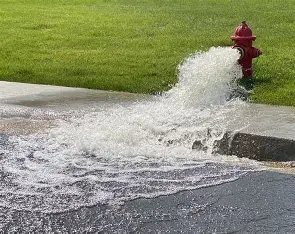
Have you ever seen an opened a hydrant valve only to watch the water go down the drain, ditch or street? It might seem like a waste, but hydrant flushing is a crucial part of water quality maintenance to ensure your health. What are some of the best practices, and why are they so essential?
The Impact of Sediment Build-up on Pipes
Over time, sediments, biofilm, and other impurities can accumulate in water main pipes, affecting the color, taste, and odor of potable water. Areas identified as dead ends are especially concerning and include areas water accumulates and doesn’t circulate, allowing sediment to settle and corrosion to occur.
Flushing “dead ends” is critical to community and environmental health, and often, we will employ an automatic hydrant flusher to maintain water quality.
Preventative Maintenance
Beyond the improved water quality, hydrant flushing serves an important preventative maintenance function. By clearing out sediment or stagnant water in the system, flushing ensures the components of the water distribution system, such as valves and fire hydrants, function optimally.
Benefits of Regular Hydrant Flushing
The main reason for flushing hydrants is to maintain high water quality. We can remove rust, mineral particulates, and other sediment that can naturally accumulate in pipes and water mains during this process.
Flushing hydrants increases water safety and enhance the effectiveness of secondary disinfection processes, greatly affecting water quality throughout the system.
Hydrant flushing not only benefits water quality and allows our staff to monitor underground pipes, but it is also crucial for public services. Firefighters rely on properly working hydrants and utilities, and flushing hydrants is a way for professionals to mark, clean, or clear brush around hydrants in case of an emergency.
If you have any questions about hydrant flushing, please contact our office, and we will be happy to help.
Thanksgiving Holiday
🦃 Holiday Closure Notice: Thanksgiving
Please note that MOUNTAIN WSC will be closed on Thursday, November 27th, and Friday, November 28th, 2025 in observance of Thanksgiving.
We wish you and your loved ones a joyful and safe holiday. Regular operations will resume on Monday, December 1st, 2025.
Thank you for your continued support.

VETERANS DAY
Please be advised that MOUNTAIN WSC will be closed on Tuesday, November 11th, 2025, in observance of Veterans Day.
We honor and thank all who have served in the United States Armed Forces. Regular operations will resume on Wednesday, November 12th, 2025.
Thank you for your understanding.

RATE INCREASE
Mountain WSC will be increasing its fees Effective February 1, 2026.
The rate increase will be as followed:
*The minimum monthly fee will increase from $59 to $70. This increase was supposed to have been in 2023, but we held off as long as possible.
Due to the rate increase from the City of Gatesville. The per-thousand-gallon rate will increase from $5 to $6.70.
Please feel free to call the office with any questions or concerns (254) 865-7113
Columbus Day

We will be closed on Monday, October 13th, 2025, to observe Columbus Day. We will resume normal business hours on Tuesday, October 14th, 2025.